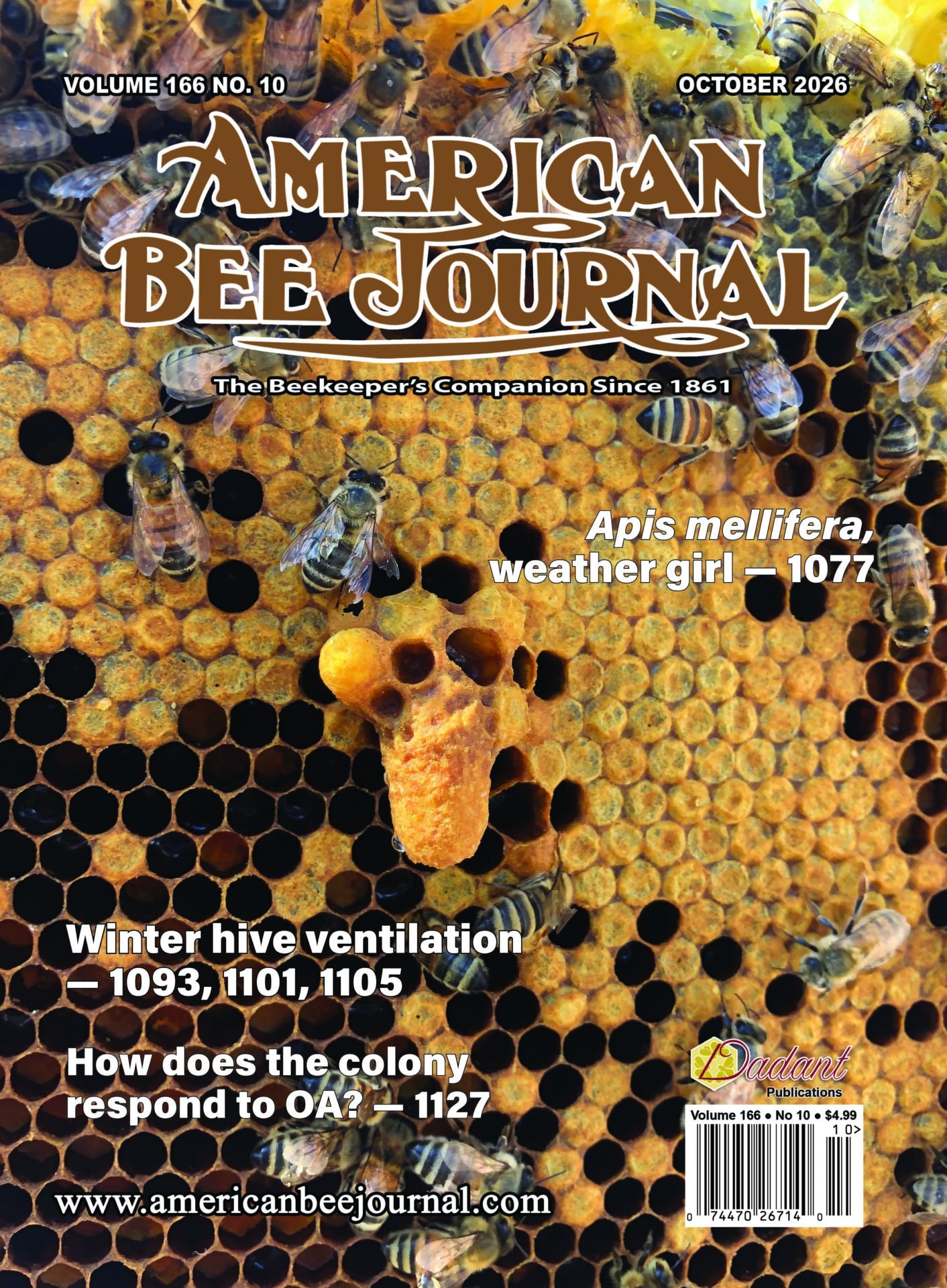

September ABJ Cover

Posted September 1, 2016
September ABJ Cover
September Cover Picture Photographer Michael LaSpina captured this excellent photo of a honey bee working Yellow Star Thistle in Northern California.
Read More September Cover Picture Photographer Michael LaSpina captured this excellent photo of a honey bee working Yellow Star Thistle in Northern California.
Read MoreBee Water and Sphagnum Peat Moss Perfect solution! Thank you so much for publishing Tibor Csincsa’s Letter to the Editor titled “More On Bees and Water” in the June 2016 issue. I have struggled over the years to develop a dependable watering solution for my bee yards where water is not readily available. Either the …
Read More
The season has been one of extremes. Earlier spring heavy rains in the Southeast and Southwest were followed by torrential rains and disastrous flooding in the Mideastern states, especially in West Virginia. Later in the spring and early summer extreme heat gripped much of the South, especially the Southwest and Southern California. Heat advisories in …
Read MoreThe 7th annual fall meeting of the Illinois Queen Initiative (IQI) will be held Saturday, October 29, 2016 from 9 am to 4 pm at the Asmark Institute Agricenter, 14171 Carole Drive, Bloomington, Illinois; Doors open at 8:30. The IQI is an organization of volunteers dedicated to educating Illinois beekeepers on rearing queens, with an …
Read MoreQ Big swarm, now what? I collected a very large swarm yesterday. It filled 2.5 deep boxes. I just happened to have 3 boxes that had all drawn comb. I did replace 5 frames with new foundation to keep them busy. My questions are: With such a large swarm, and now the queen will start …
Read More
Genes related to hormone signaling and sex cell division let worker bees reproduce asexually PLOS Parasitic Cape honey bees exploit and overrun other honey bee colonies by triggering changes that let worker bees reproduce. This social parasitism is enabled by differences in several gene regions, including some related to hormone signaling and chromosomal segregation, report …
Read MorePurdue University WEST LAFAYETTE, Ind. – A Purdue University study shows that honey bees collect the vast majority of their pollen from plants other than crops, even in areas dominated by corn and soybeans, and that pollen is consistently contaminated with a host of agricultural and urban pesticides throughout the growing season. Christian Krupke, professor …
Read More
There have been a few inquiries regarding two-queen systems since my last article. There are several methods of making a two-queen colony. Some others may be more productive than the horizontal method to which I am committed. Most two-queen systems have extracted honey production as a goal. Double-queen systems date back many years. Farrar reported …
Read MoreAs a follow-up to my last article, I will continue to discuss the major stressors of honey bee colonies. I covered the main biotic stressors (pest, pathogen, predator, parasite) of honey bee colonies in my July article. Now, I will discuss the other major stressors of honey bee colonies: managed-related stressors, nutrition, queen-related stressors, and …
Read MoreIt’s hard to write a biology of the honey bee and not pause to linger over the waggle dance – one of the most celebrated examples of animal communication and a window into all sorts of questions about the honey bee’s evolution and modern functioning as a superorganism. Indeed, the waggle dance figures prominently in …
Read More"I want the American Bee Journal to be the finest publication about bees and beekeeping in the world."
- C.P. Dadant, Editor of ABJ 1912-1938
THE AMERICAN BEE JOURNAL
51 S. 2nd St., Hamilton, IL 62341
Phone: 217.847.3324
Fax: 217.847.3660
info@americanbeejournal.com

©2026 Copyright the American Bee Journal. All Rights Reserved.
website developed by CleverOgre