
ABJ OCTOBER 2021 Cover

Posted October 1, 2021
ABJ OCTOBER 2021 Cover
Honey, I’m home! Emily Skeels of Santa Rosa, California, took this photo several summers ago in Frenchtown, Montana.
Read More Honey, I’m home! Emily Skeels of Santa Rosa, California, took this photo several summers ago in Frenchtown, Montana.
Read More
Q Stubborn Bees I do approximately 100 or so removals each year. I have removed bees in some peculiar places. However, on this trap-out, the bees decided to thumb their nose at me and just move outside the trap (Figure 1). They will not quit! Two days later, after a good soaking rain, the bees …
Read More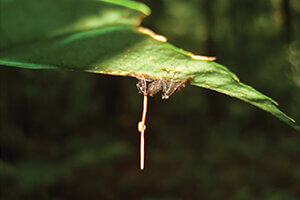
Researchers at Washington State University aim to develop the biocontrol agent as a commercial product Deep in the Brazilian rainforest, if you look closely enough, you might find a gruesome scene: Like a sinister sewing pin, a fungal plume sprouts from an ant’s body. The ant, still hopelessly clinging to a leaf even after death, …
Read More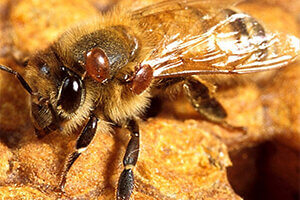
You have undoubtedly read or discussed or listened to (one or more) YouTubes on varroa mites — perhaps you have digested a great deal about mites? August and September represent our last best chance to obtain varroa mite control. High mite numbers can lead to high deformed wing virus (DWV) levels and sudden colony death. …
Read More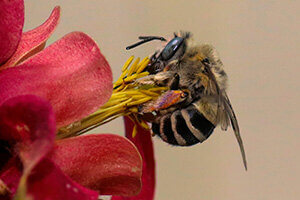
It wasn’t long ago that nearly all beekeepers came into the practice from some agrarian pursuit. These people were gardeners, farmers, orchardists, or dairymen who recognized the benefit of keeping honey bees. Later, others got into it because beekeeping was part of a treasured childhood. How often do you hear, “My father kept bees” or …
Read More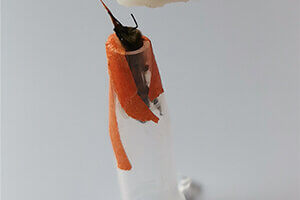
While the varroa mite is the most important and widespread pest of honey bees across the world, a different mite, Tropilaelaps mercedesae, may be a bigger threat. Tropilaelaps (Photo 1) is smaller than varroa, has a faster reproductive rate, a shorter phoretic phase (i.e., the phase when mite is on adult bees and is most …
Read More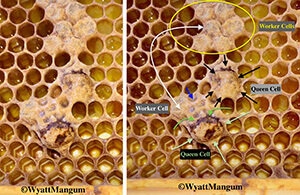
One of my big bee management jobs begins toward the end of the swarm season. I inspect all my colonies to make sure each one has a laying queen. Definitely by the end of June when our spring nectar flow is winding down, I need to be finishing with my queen inspections. Especially for colonies …
Read More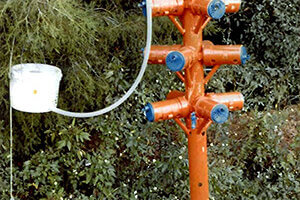
You have undoubtedly read or discussed or listened to (one or more) YouTubes on varroa mites — perhaps you have digested a great deal about mites? August and September represent our last best chance to obtain varroa mite control. High mite numbers can lead to high deformed wing virus (DWV) levels and sudden colony death. …
Read MoreA New Honey Label? Obstacles, Obfuscation and Optimism M.E.A. McNeil – 971 Build a Multi-use Robbing Screen Mike Haney – 979 How the Honey Bee Came to Mexico Peter L Borst. – 985 A Comparative Trial of the Pollen Subs 2020 — Part 3 Randy Oliver – 997 Observations on Pollen Subs — Part 2: …
Read More
Sarah Adkins took this photo of her husband, Travis, working bees in southwestern Oklahoma. The hives were on an alfalfa field.
Read More"I want the American Bee Journal to be the finest publication about bees and beekeeping in the world."
- C.P. Dadant, Editor of ABJ 1912-1938
THE AMERICAN BEE JOURNAL
51 S. 2nd St., Hamilton, IL 62341
Phone: 217.847.3324
Fax: 217.847.3660
info@americanbeejournal.com

©2026 Copyright the American Bee Journal. All Rights Reserved.
website developed by CleverOgre