

For my collection of American Bee Journal and Bee Culture journals, back to their first issues, I took a bank loan to buy them back around 1987. Of course, now anyone can get digital copies. Both suffer from the same information loss, important for historical studies: The wraps are missing from the bound volumes, or the digital copies I have seen.
In the old formatting, the text was not interspersed with advertisements. Rather, advertisements were wrapped around the text. When binding the journals, the wrap of advertisements, largely duplicated between adjacent issues, were removed to thin the bindings and save shelf space. Aesthetically, removing the wraps destroyed photographic scenes on the covers. Before photography, beautiful artwork that once adorned the covers was lost too.
While not common, I try to acquire consecutive runs of issues with their wraps whenever I can. Their dates need to be appropriate because they are expensive. In the late 1870s, American apiculture was in a transitional time of innovation, testing all sorts of new equipment designs. That era was a creative time, but most beekeeping equipment would be ephemeral. Behind each one was a beekeeper’s idea, and the hope and dream to be successful, and maybe win a measure of financial security. I was lucky enough to find the year 1877 of the American Bee Journal, complete with wraps and all. So let’s look at some of its historical artifacts in the days
when they were new.
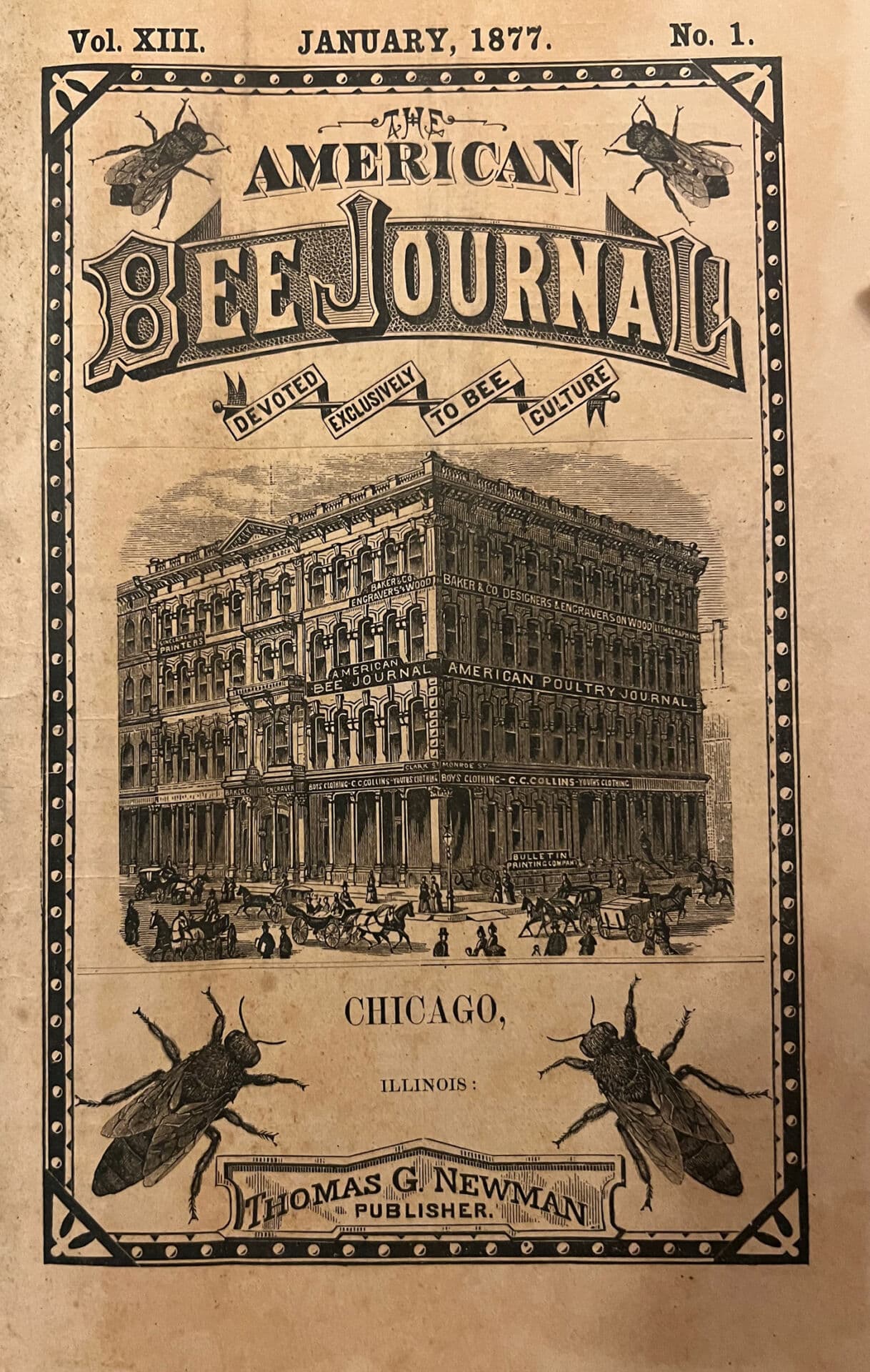
Figure 1 shows the January 1, 1877 cover of the American Bee Journal. At the time, Thomas G. Newman was the publisher, and the journal’s location was at Chicago, Illinois. The cover shows a prosperous location in the city, probably where the American Bee Journal was being published. The May cover changes, arriving in green, and shows the premier honey products of the time (see Figure 2) …