

Wait … that’s not demaree!
 Although never a beekeeper, I have been an ABJ subscriber for over 50 years and every month I find something of interest in the magazine. Tina Sebestyen’s “The Demaree Method of Swarm Control” in the April 2026 issue was very educational. George W. Demaree was my great-great-uncle and thus I always enjoy articles about Demareeing. But the photo accompanying the article is not George W. Demaree.
In the December 1956 ABJ there is a nice biography of Demaree by William Eaton titled “Beemaster — Not Just A Beekeeper.” Eaton said there are no known photos of Demaree. In a near fatal accident as a young boy, Demaree was run over by a wagon, leaving a sunken place the width of two fingers on the right side of his face. The resulting scar had a drawing effect on his eye leaving him sensitive concerning his appearance and adverse to photos. My grandfather jokingly told Eaton, “He wasn’t pretty and he wasn’t homely, rather, he was both — pretty homely!”
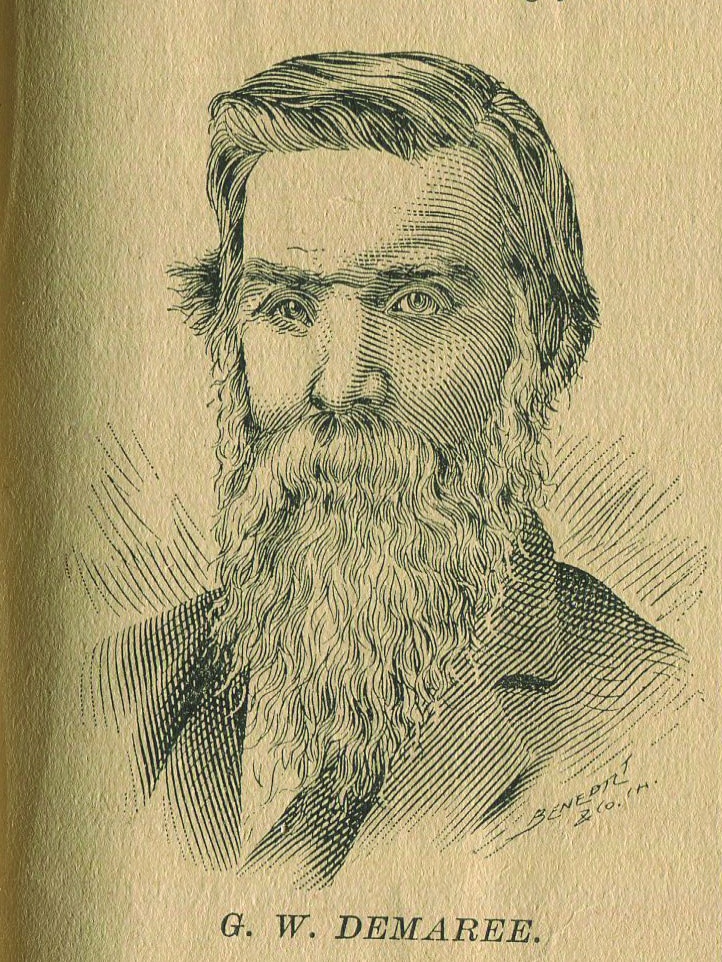
But he did have a photo. The March 6, 1893 ABJ (page 328) presented “for the first time” the face and life-story of G.W. Demaree. The “face” was an engraving (at left) showing the right eye drawn down as described in Eaton’s article. In the early 1970s I found the photo from which the 1893 engraving was made and enclose it now for the readers to see the real George W. Demaree of swarm control fame.
So who is the gentleman pictured in the April 2026 ABJ (page 379)? I first saw him incorrectly identified as Demaree in 2020. He does look similar, but without the right eye drawn down. A short time later, reading my October 2020 ABJ, I saw one of Peter Borst’s always fascinating beekeeping history articles (Borst, “The Gold Rush and the Honey Bee”) with a photo of the same man correctly identified. The gentleman is the pioneer California beekeeper John S. Harbison (1826-1912), a contemporary of Demaree.
Vince Akers
Indianapolis, Indiana
Eugene responds:
Hi Vince,
It’s neat to learn that a Demaree descendant (even a non-beekeeper) is reading the magazine, and I appreciate that you find it interesting and informative.
Thanks for pointing out the error. I’ve no doubt that Peter would have quickly caught that too if he were still here! I’d love to blame Tina, but I believe I sourced that photo online for the story. I just now did a Google search for George Demaree and the Harbison photo came up immediately. I’m glad you mention seeing that mis-identification elsewhere as well, so readers don’t get the impression that “any old guy with a beard” is close enough for this magazine!
Eugene
Do drone pheromones attract queens to DCA’s?
While reading the article “Where Do Honey Bees Mate?” by Gard W. Otis (May 2026), it occurred to me that since pheromones play a big part in honey bee communication, is it possible that drones emit pheromones which may attract queen bees to drone congregation areas?
Joseph Treimel
Pleasant Valley, NY
Dr. Otis responds:
Good question, Joseph.
People have been chasing drone pheromones for 40+ years, with the most intriguing paper published from Christina Grozinger’s lab at Penn State U. (Villar et al., 2017): https://doi.org/10.1007/s10886-017-0912-2)
In my Apidologie paper (https://link.springer.com/article/10.1007/s13592-025-01237-1), I summarized in Section 8.2 (“Are drone pheromones important in honey bee mating?”) the evidence that a drone-produced pheromone may be attractive to queens. It does seem to be attractive to drones. The functionality of the pheromone in honey bee mating biology remains unclear.
Gard