


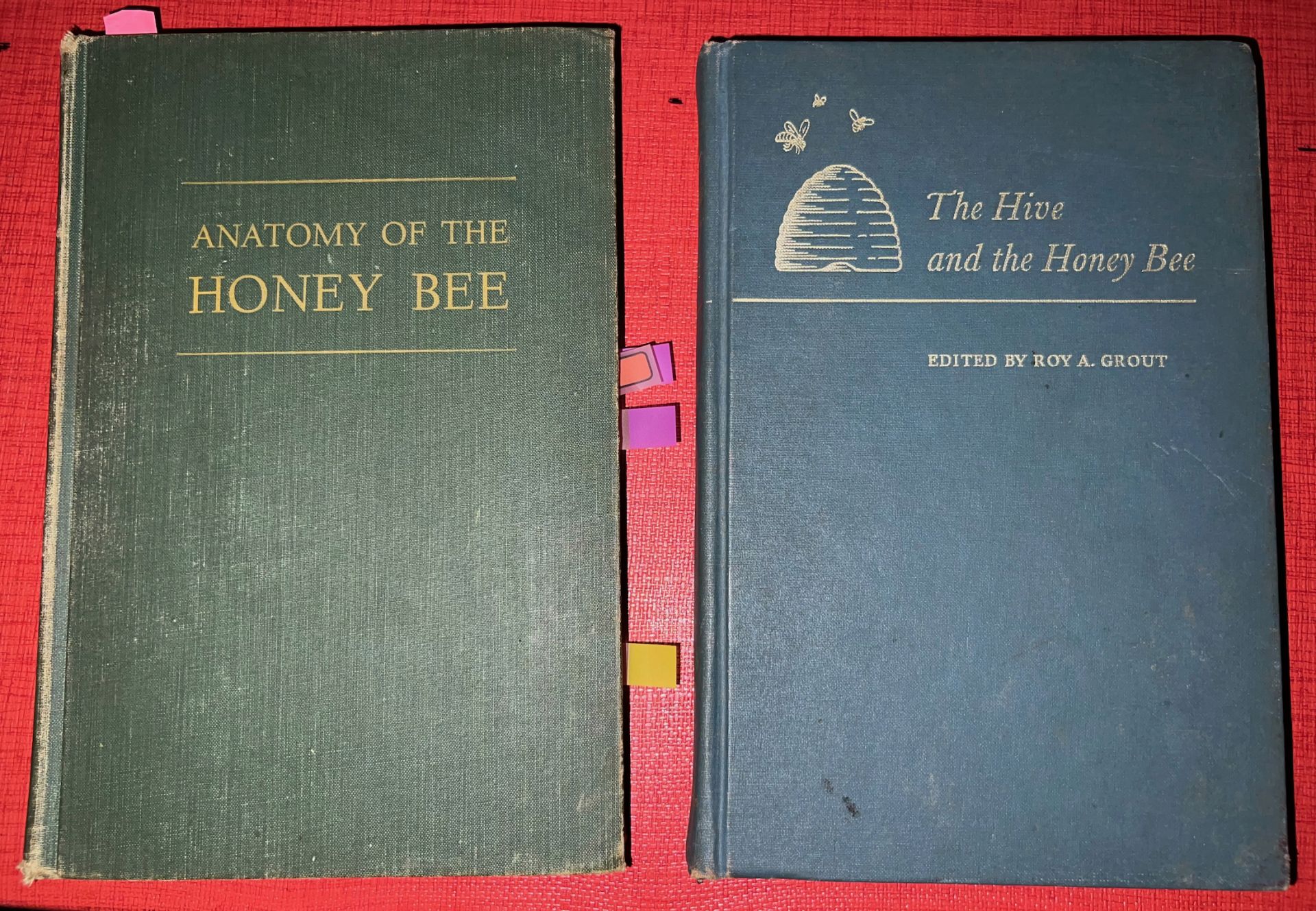
My first memorable brush with honey bee anatomy came at the Christmas of 1968. As a kid of 12, we did not get much, but I wanted the book “The Hive and the Honey Bee” (Figure 1, right). While I was wide-eyed for the pictures of queen cells and queen bees, Chapter 5 had a detailed summary of honey bee anatomy by the famous insect anatomist R.E. Snodgrass.
In July of 1974, I acquired the monograph of Snodgrass’s “Anatomy of the Honey Bee” (Figure 1, left). Later on, I acquired a copy of “Anatomy and Dissection of the Honey Bee” by H.A. Dade. I used that book with my dissecting microscope, bought from a scientific supply company, to learn bee anatomy. All this study was years before before tracheal mites or varroa mites came to the U.S.
These bee anatomy books have black-and-white diagrams. For example, Figure 2 shows the forewing from Snodgrass’s 1956 anatomy book. Later books added color to the diagrams, helping the students distinguish organs and muscle groups. Bee anatomy books with flat pages, and screens of digital reprints of the old texts, all have one limitation for me (and others); they are two-dimensional.
In teaching labs for bees, anatomy books could of course direct the dissection of a worker bee, bringing a three-dimensional understanding to bee anatomy. Teaching labs, at least some of them, must have had bee models showing anatomy. Somewhere in my historical searching, decades ago, I remember seeing old styles of bee models. They were probably on a shelf in a bee-lab picture from Europe. At the time I was searching for other things (hives, smokers, etc.), figuring bee models were not even in the realm of possible acquisitions.
In December 2024 that reality abruptly changed. I had the chance to acquire my first bee model from Europe (see Figure 3). First, I had to check a few things. One was, does the bee model have three-submarginal cells as we saw from above? It did. (On any “model” or picture of a honey bee, I have to check the submarginal cells. The character is easy enough to see, and subtle enough to overlook as a basic test for attention to detail.) I planned to use this bee model in these column articles when explaining some point of internal anatomy that is shown in the model. Being rare, I thought the probability was quite low of finding another bee model, say, a different one. The trouble with low probability is that sometimes it is not as low as you think.
In April 2026, I had a chance to acquire another bee model from Europe, larger and older than the first one. Getting this model called for extra packing cost, more complicated shipping, and expensive tariffs. No matter, when collecting, I will work to solve all the logistical problems, and drive to pick up something when all else fails. Except usually I do not have the Atlantic Ocean in my way …