

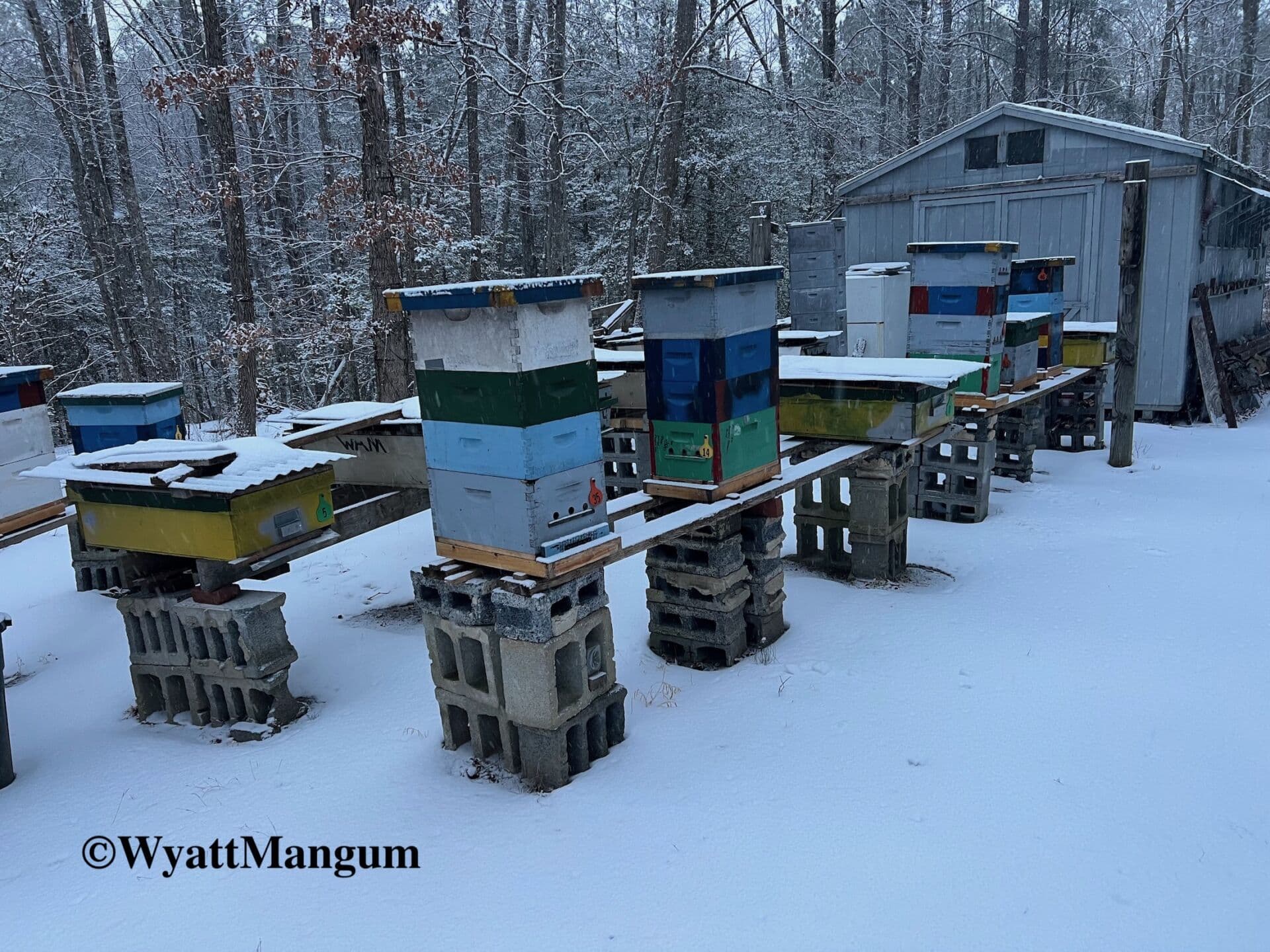
In the winter of 2025/2026, Piedmont Virginia had long periods of subfreezing cold that were unusual for us. Normally our snow melts fairly quickly, but not last winter. My once or twice daily visits to the bee house were on ice-covered snow (See Figure 1).
I had seven three-comb top-bar nucs that were observation hives wintering in the bee house. These hives were the focus of my main research at that time (see Figure 2). Eventually, I want to have 20-30 of these colonies surviving the winter to provide early, locally adapted queens for the following spring. With an expectation of a surplus of young queens, I want to make sure I can overwinter them.
One large 12-frame observation-hive colony was wintering in the bee house too. This hive has three medium frames across with four tiers (layers) high for a total of 12 frames. This hive is the main focus of the following example (see Figure 3). For reference, Figure 4 shows a colony in a 12-frame observation hive in warm weather.
On February 6, 2026 at 5:30 p.m., the outdoor temperature in the bee yard by the bee house was 28°F (-2.2°C ). Not much snow melted that day. After my work on the top-bar nucs, I briefly photographed the 12-frame hive, if I was not too cold. (The bee-house temperature tracks the outdoor temperature by a few degrees.)
Figure 5 shows the complete front side of the hive and the edge of the cluster. Figure 6 shows a closer view of the winter cluster, just the edge. I had already quickly sketched (in red) the cluster boundary at about 28°F (-2.2°C) on the plexiglass. This slice of cluster does not contact the hole in the comb (to the upper right of the bees). The bee number here should remain a constant, until the bees break cluster by a warmup or a disturbance, unless some bees become sick and self-evict themselves from the cluster.
With Figure 6 in mind, a beekeeping idea comes to mind, concerning putting holes in all the combs so bees in the winter cluster can move internally through them, instead of having each “slice” of bees between its combs trying to survive on their own. But the bees mostly just refill these holes in the comb; that was the result when I made hundreds of holes in top-bar combs in several apiaries. From wintering indoor hives, both frame and top-bar hives, I have seen in the bitter cold, right when one would want bees moving between combs, often the cluster contracts away from the hole …